Image

Author Archive for Amy Lenzo – Page 28

Welcome to the Beauty Dialogues!

The Beauty Dialogues is here to illuminate the beauty of this world – not just the beauty of form, but also the patterns of essential wholeness that go beyond the visible.

Wholeness dissolves the illusion that life and work are separate so sometimes I write about design and the language of online communications, but it’s always about what, to me, life looks like through a beauty-lens.

Design Deliberations

I was reading something in Chris Brogan‘s blog the other day on blog design, a solid informative post about basing each design decision on its congruence with your blog’s intended use. At last count this piece had drawn 61(!) comments from his readers, many of them appreciative of Brogan’s suggestion to use a thinner header to take full advantage of valuable page "real estate".

I  wrote a long comment myself, in part promoting the idea of a more expansive banner, because sometimes an image is as valuable (if not more so) as anything else you could say. This fact may not be immediately apparent in the largely left-brain logic of the marketplace, but it is no less true. Daniel Pink’s A Whole New Mind gives a wonderful exposition of why right-brain creativity is an increasingly important component in today’s world.
Lily_white
One of the great things about a blog is how easy it is to change it, and I tend to be continually tweaking and fine-tuning my "look and feel" and sidebar content. This new banner, for example, is a radical departure from what I’ve done here in the past.

Even though it intuitively felt right, I must admit at first I was nervous about using black in the beauty dialogue color scheme, since I usually have a more literal focus on light. Then I saw these lines from Anam Cara, by John O’Donohue, and knew I was ok:

"We need a light that has retained its kinship with the darkness … All creativity awakens at this pivotal threshold where light and darkness test and bless each other. You only discover balance in your life when you learn to trust the flow of this ancient rhythm."

The power of visual language is undeniable, perhaps because it speaks not only to our conscious, logical brain, but also to our unconscious, poetic intuition and imagination. Like Pink, I believe that gaining intuitive fluency is one of the most important skills you can develop, as a designer and as a human being.

But what do you think? What are some of the design decisions you have made and why did you make them? Where does your own balance lie between logic and intuition?

Annie

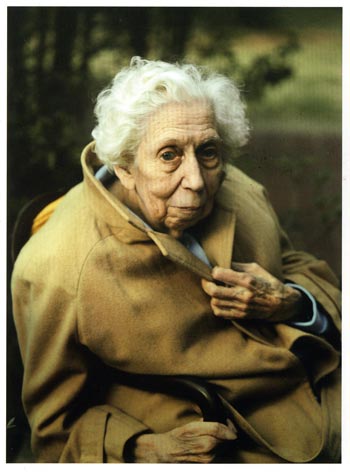
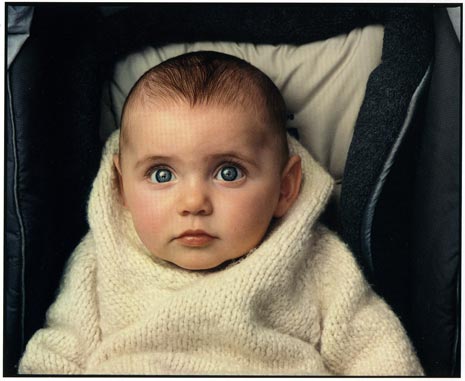
What stays with me from Annie Leibovitz‘ photographic exhibit (and the book it illustrates: A Photographer’s Life: 1990-2005) is her decision to integrate her personal and professional photography into a seamless whole. As she says, "it is one life, not two".
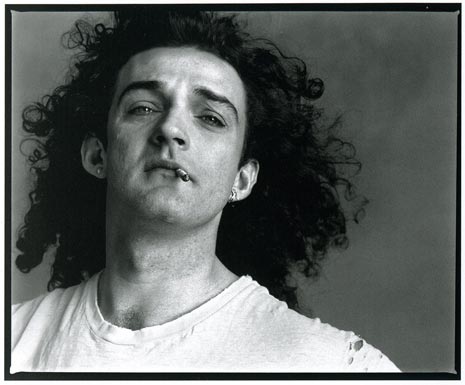
Perhaps being married to Susan Sontag and having close personal ties with many famous people has helped blur her line between intimate and public, but I think it is more to do with the level of her gaze, that seems to see pretty much everything with the same measure. There were many stunning portraits among her collection, but the ones that stood out for me were the ones where it seemed her subjects met this gaze head-on. Here are Annie’s photographs of Mark Morris, Eudora Welty and Sarah Cameron Leibovitz, to show you what I mean:

Morris

Welty

Sarah

Mary Oliver’s Poetry

Las night I went to hear the legendary poet Mary Oliver read. It warmed my heart to see the hall packed for this white-haired woman whose philosophy after all is so simple – kindness and attention to beauty are its main principles.

When asked about her daily practice, Oliver said she wakes every morning to witness (my word) the dawn and give thanks for another day, then she eats breakfast, takes a walk with her dog Percy, and works for 3-4 hours, at which point she is tired. Hers sounds pretty much like a perfect life to me.

Mary Oliver is one of those old-fashioned wordsmiths who doesn’t use a computer – she writes her drafts and revises them on a notepad before transcribing the finished work on a series of old typewriters (if they stop working she lets them rest under her chair for a few weeks, when, she says, they are almost always miraculously healed and ready to go again).

From her latest volume, Red Bird, "Invitation":

Oh do you have time
to linger
for just a little while
out of your busy

and very important day
for the goldfinches
that have gathered
in a field of thistles

for a musical battle,
to see who can sing
the highest note,
or the lowest,

or the most expressive of mirth,
or the most tender?
Their strong blunt beaks
drink the air

as they strive
melodiously
not for your sake
and not for mine

and not for the sake of winning
but for sheer delight and gratitude–
believe us, they say,
it is a serious thing

just to be alive
on this fresh morning
in this broken world.
I beg of you,

do not walk by
without pausing
to attend to this
rather ridiculous performance.

It could mean something.
It could mean everything.
It could be what Rilke meant, when he wrote:
You must change your life.

The red bird motif runs through this sweet book of love like a red thread of inspiration, ending finally with the poem Red Bird Explains Himself.