With all my musing lately on slow work, and slow blogging, I was very excited to hear about my friend Nancy White’s extrapolating on this idea in what she calls slow community. In her inimitable capacity to identify patterns and make connections, she’s been talking about how quickly the interconnectivity of the web has grown beyond our abilities to stay connected in meaningful ways. (This image is a "splat map" of the internet’s growth since its beginnings in ARPANET (the green bit in the middle):
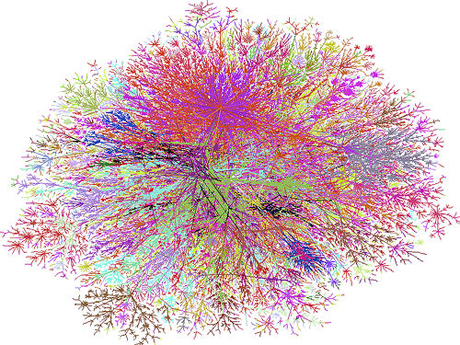
Variations on this theme are being discussed all over the media – two books among my own pile of bedtime reading focus on the topic in one way or another; Peter Block’s new Community: The Structure of Belonging, and Dot Calm (I love that title) – but what I particularly like about the concept of slow community is that it offers us a context with which to negotiate this growing nexus of interactivity on our own terms.
On a personal level, I long for a slower more reflective life, and I crave the depth and reflectivity and true connection that is possible within communities – online and off – that share these values.
On a professional level, the idea of "slow community" gives a conceptual framework to the online communities I help facilitate, or steward, through which we can identify and "see" ourselves. It also gives us a sense of what we might be evolving towards, or the kind of depth we might WANT to nurture between ourselves.
Some have spoken about the depth and quality of our attention as a key to slow community. I strongly believe that it’s possible – and as difficult – to be as deeply connected through our online communications as it is anywhere else. The online medium has its own challenges, of course, but it also has advantages, and one of them can be time. For all its limitations and lack of physical cues, writing is a slower medium than speaking. Writing gives us the time to reflect and consider those responses that can just "pop out" as unthinking reflexivity in real-time interaction and craft them into shapes that can more clearly carry the meanings we want to convey.
One might also ask whether the word community can be used to define all the ways we interact online. Is Twitter a community? Are the people who read my blog a community? I’m curious about what the boundaries are, or what the defining features of community are for different people.
For myself, I actually think this question of what community is and isn’t refers back to my earlier point about quality or more accurately, intent. In this framework, the word might be applied to any communication where the intent is to "commune", be that on Twitter, or within our blogging readerships, online conversations, or physical neighborhoods for that matter.
Having the intent to commune with each other requires an altogether different relationship to time. There’s something here about respecting time and entering into interactions with a
"presence" that makes the most of it, that expands time so that there’s
enough for whatever is needed.
Someone left a comment on one of Nancy White’s posts on this subject, bringing up the Quaker model where they moved VERY slowly as a community in discussing the challenges of slavery, and yet were still the first to stand up and call for abolition. This example shows us that slowness doesn’t necessarily mean an inability to respond to the challenges of the day, but rather offers the capacity to respond in a more profound and ultimately even more timely way.
* * * * * *
Here’s a video from a presentation on the subject that Nancy did at Zaadz (now the Gaia Community), which has some terrible sound production, but asks some great questions:
She’s also created a page on her online facilitation wiki devoted to slow community, which in turn has links to other helpful resources.



Welcome!